
NAASC (current & former members) fundamental biology publications
Plants are essential for life as we know it on Earth. They oxygenate the atmosphere, regulate the climate, and comprise much of the primary producers underpinning complex food systems. In the 1980s, a multinational group of plant scientists chose the small angiosperm—Arabidopsis thaliana—to serve as the model flowering plant for genetic and molecular studies that would be leveraged to produce vast new datasets, resources, and tools. The rationale they used to persuade funding agencies to make significant investments and focus intense effort on this single plant species was to produce a deep fundamental knowledge of the biology of plants and to apply this knowledge to valuable, but typically less tractable, plant species. Over the past 40 yr, Arabidopsis has emerged as the most powerful and versatile plant model to uncover core biological principles and served as a prototyping system to test advanced molecular and genetic concepts. We argue that the emerging challenges of accelerating climate instability and a rapidly growing global population call for renewed and robust investments in fundamental plant biology research. Leveraging the power of Arabidopsis research, resources, datasets, and global collaborative community is more important than ever. This commentary lays out a vigorous defense of foundational, i.e. “basic,” plant science research; describes that often, Arabidopsis is preferable to working directly in crops; highlights several transformative applications generated from basic plant research; and makes the argument that plant science is vital to the survival of humanity.
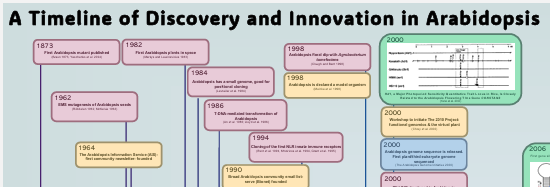
NAASC presents a timeline highlighting some of the exceptional discoveries, innovations, and community milestones in Arabidopsis research over the past 150+ years. This timeline showcases multinational Arabidopsis efforts from as early as 1873 to the present, divided into five categories: technology, community, landmark paper, resource, and application. The technology category encompasses novel discoveries and research that have been particularly critical for advancing plant science into the 21st century. The community category showcases activities that helped to establish the Arabidopsis research community and enabled its evolution. The resource category features new tools and resources developed by the Arabidopsis community, such as the creation of the Arabidopsis seed stock centers and online databases. The application category highlights key technologies and plant products that have been made possible through fundamental Arabidopsis research efforts.

Our purpose was to re-envision how outreach programs are funded, evaluated, acknowledged, and shared within the plant science community. We provide a roadmap to re-envision how outreach programs are funded, evaluated, acknowledged, and shared within the plant science community…a comprehensive resource for students and young faculty interested in developing effective outreach programs.

Discusses the "Big Questions” that could coalesce future research in plant biology. The Big Questions are described as strictly biologically motivated, but have obvious applications to plant improvement, the bioeconomy, and human and environmental health. We hope this article will be an inspiration to beginning and established scientists, corporations, and funding agencies to capitalize on the reference species Arabidopsis thaliana.

Effective research, education, & outreach efforts by the Arabidopsis thaliana community depend vitally on easily available and publicly-shared resources. This paper focuses on several challenges, including the need for reliable & current annotation, common standards for data & metadata, and accessible & user-friendly repositories/tools/methods for data integration & visualization.

This article discusses the skill sets and core competencies needed to underpin quantitative and computational approaches that are becoming increasingly important for addressing current and future opportunities and challenges in plant biology.

Many discoveries with direct relevance to human health and disease have been elaborated using Arabidopsis, and several processes important to human biology are more easily studied in this versatile model plant.

The Arabidopsis community can lead the way for the plant sciences through the integration of diverse data sets and the development of new computational tools and resources that will facilitate the transfer of knowledge to crops and other economically and agronomically important species.

Presents a citational network analysis of 54,000+ Arabidopsis papers, and touches on some of the important discoveries in plant biology that have been made in this powerful model system, and highlights how these discoveries have then had an impact in crop species. We also look to the future, highlighting some outstanding questions that can be readily addressed in Arabidopsis.

The rapid expansion in many data types, the international basis of the Arabidopsis community, and changing priorities of funding agencies suggest the need for changes in the way informatics infrastructure is developed and maintained. This article proposes a single core resource that is integrated into a larger international consortium of investigators.
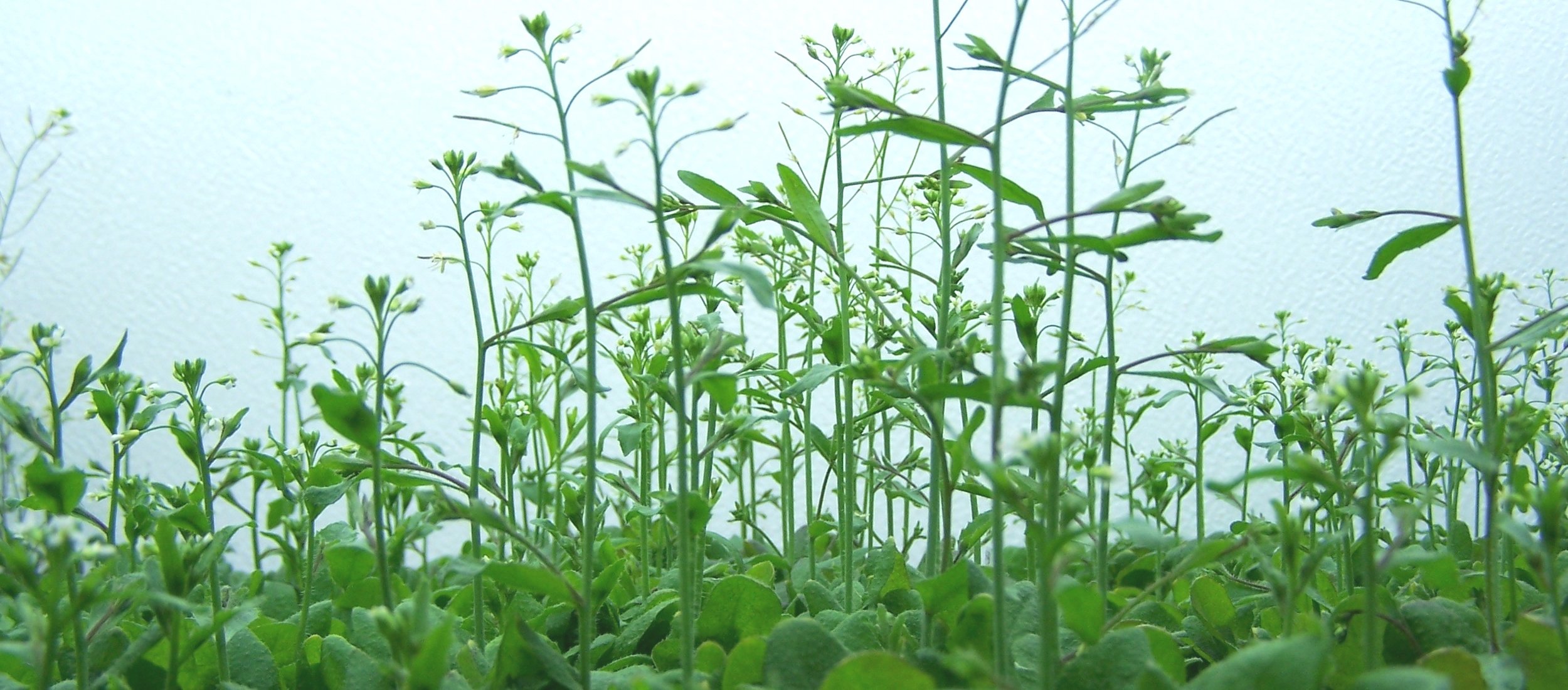
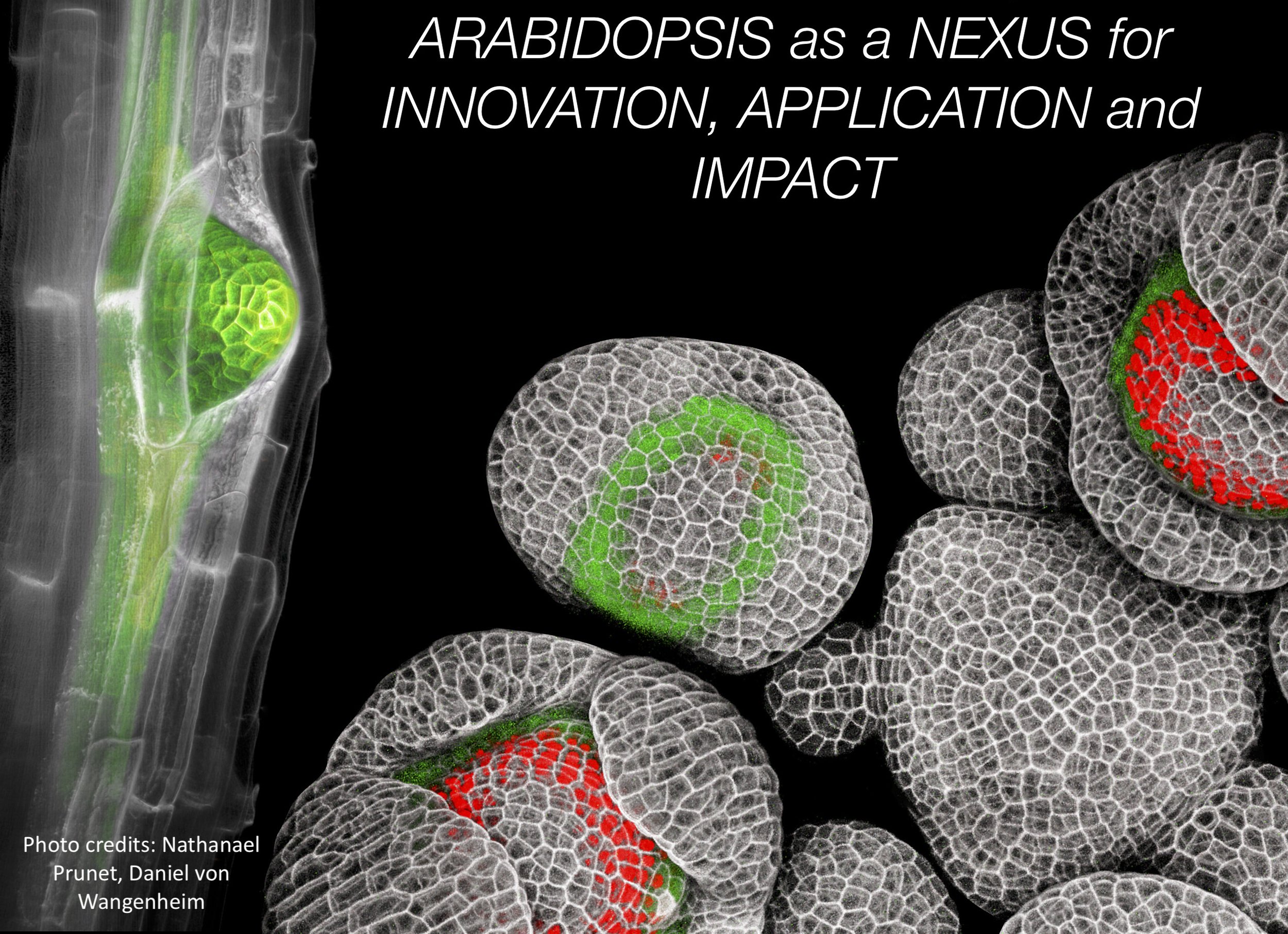
Our Support of Fundamental
Plant Biology
Sometimes called ‘basic' research, fundamental research addresses intrinsic biological questions.
This curiosity-driven research underpins many ‘applied’ successes; however, the path from fundamental to applied is rarely a straight line.
Symposia & Workshops
A sampling of NAASC’s Fundamental Biology activities
Public symposium: Seeds of Change: Using Plants to Broaden the Impact of Science in Society (at the Univerity of California, Davis)
IN PLANTA: Inclusive Practices Leveraging Arabidopsis as a Nexus for Training and Application (International Conference of Arabidopsis Research 2022)
Improving Outreach in Plant Science (International Conference of Arabidopsis Research 2022)
Communicating Science in the Age of Fake News: Broadening Your Impact (International Conference of Arabidopsis Research 2018)
Data Carpentry (International Conference of Arabidopsis Research 2017)
ATAC-seq hands-on workshop on mapping chromatin accessibility and TF footprints (International Conference of Arabidopsis Research 2017)
Hackathon for high-throughput phenotyping (International Conference of Arabidopsis Research 2017)
Emerging Genomics Techniques and the Future of Research using Arabidopsis thaliana (International Conference of Arabidopsis Research 2016)
Bioinformatics, Quantitative Techniques & Computational Skills: Current Research & Future Training Needs for 21st Century Plant Biology (International Conference of Arabidopsis Research 2015)
NAASC workshop report: 2020 Vision for Biology Workshop: The role of plants in addressing grand challenges in biology-"Plant Systems 2020: A systems understanding of development and adaptation at the level of cells, tissues, organisms and ecosystems”
NAASC workshop report: Mid-course assessment of the 2010 Project
Plant Physiology Journal, 2000, Workshop: The 2010 Project" functional genomics and the virtual plant. A blueprint for understanding how plants are built and how to improve them
Workshop Report, 2005 Workshop on Data Integration within the International Arabidopsis Community
Report- Long-Range Plan for the Multinational Coordinated Arabidopsis thaliana Genome Research Project
Improving Outreach in Plant Science- Jose Dinneny, Stanford University, International Conference of Arabidopsis Research 2021
Rapid-cycling Brassica rapa as an Educational Model Plant- Rick Amasino, at a workshop held by the North American Arabidopsis Steering Committee
Democratizing Science Education -Alexandra Schnoes, at a workshop held by the North American Arabidopsis Steering Committee
Improving Science Literacy Through Art- Roger Hangarter, at a workshop held by the North American Arabidopsis Steering Committee
“When I was making the transition from working with Arabidopsis to working in [the] biomedical [funding environment] I was happily surprised to learn that much of the knowledge I accrued during my almost 40 years with Arabidopsis was directly relevant to understanding the biomedical literature; the basic tools and cell and molecular biology were quite portable.”
Collaborations


