
Meet Adrienne Roeder, former NAASC Member…
An interview by former Early Career Scholar NAASC member Dr. Vincent Cerbantez-Bueno, of the University of California, Riverside, USA
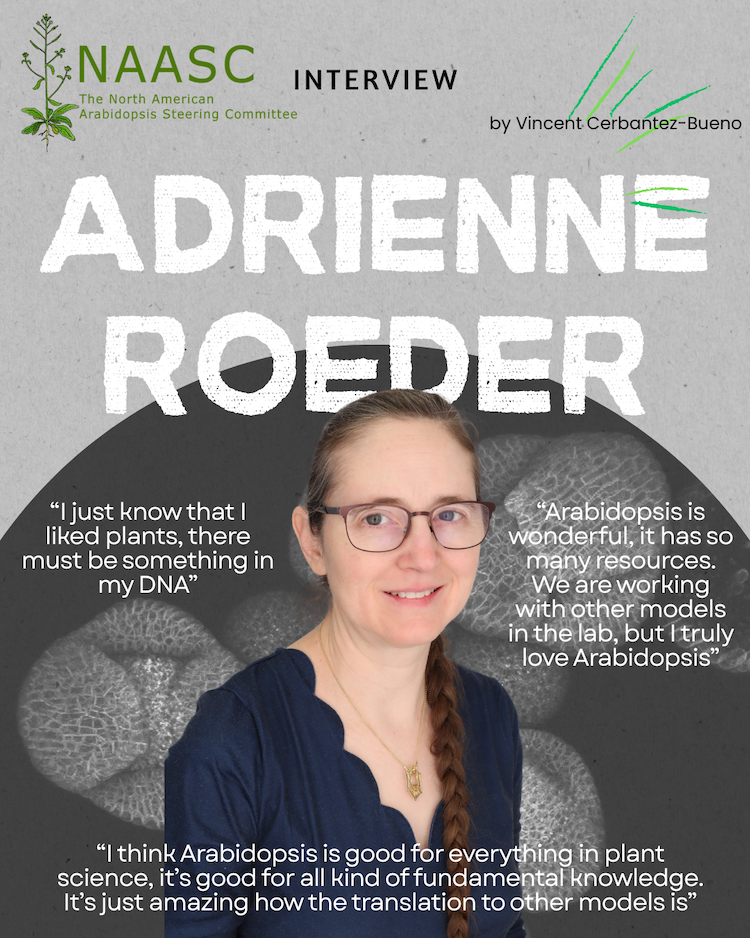
Adrienne Roeder was elected to the North American Arabidopsis Steering Committee (NAASC) in 2020. Her five-year service concluded with her serving as NAASC president, contributing to a recent issue of The Plant Cell Journal, and being actively involved in ICAR 2024 (the annual international Arabidopsis conference).
Adrienne was elected to NAASC in 2020 and served until 2025.
Roots and Personal Journey
Adrienne Roeder grew up in a suburb of San Diego, in La Mesa, California, and her love for plants began at an early age. “I just know that I liked plants,” she says. “There must be something in my DNA. In high school, I remember doing science fair projects that were always related to plants.”
She pursued her undergraduate studies at Stanford University, where she had her first encounter with Arabidopsis. “I was looking for an undergraduate research position (because I knew I wanted to do research), when I saw a sign at the biology office looking for someone to work on plant embryogenesis, that sounded so cool!” “In that lab, I remember being a little confused about what kind of biologist I was, until I saw my name on my picture labeled with Plant Cell Biologist, then I thought, Oh! I’m a Plant Cell Biologist!”
After graduating, she decided to go to graduate school, where she was unsure whether she would still work with plants, so she explored other systems.
“I applied to mostly programs that were broad biology programs, and I went to UC San Diego because they had both plant and animal biology, which I thought would be great. I remember doing one rotation outside of plant biology, in bacteria. However, it turned out that I really needed to be able to see my model organism. That’s when I realized I really loved plants.”
She ended up joining Martin Yanofsky’s lab studying flower development. Later, as a postdoctoral researcher in Elliot Meyerowitz’s lab at Caltech, she explored how plants grow and pattern their organs. “At the time I was going to start my postdoc, everyone was imaging the shoot meristem, so I decided to focus on sepals.”

Adrienne at the 34th International Conference on Arabidopsis Research (ICAR 2024) that she helped co-organize while on NAASC, following the inaugural Philip N. Benfey Arabidopsis Community Lifetime Achievement Awards Panel featuring (from l-r) Joanne Chory (Salk Institute), Chris Somerville (retired), and Joe Ecker (Salk Institute).
Awardees not pictured as they joined by Zoom: Jeff Dangl, NCSU, and Elliot Meyerowitz, CalTech. Panel recording available online.Picture taken July 19, 2024. Contributed by Adrienne Roeder.
Career in Arabidopsis
Adrienne is now a professor at Cornell University and dedicates her work to studying Arabidopsis. “We are working with other models in the lab, but I truly love Arabidopsis. Arabidopsis is small and has a ton of resources that make it easy to study. That means that we can do the detailed mechanistic work in Arabidopsis that I really want to do.”
“I think Arabidopsis is good for everything in plant science; it’s good for all kinds of fundamental knowledge. It’s just amazing how well it translates to other plants. The findings that we have made in Arabidopsis have really accelerated what we can do in crops. It’s never just that Arabidopsis informs other plants, other plants inform Arabidopsis too, like a full circle. It’s always going around in both directions.”
Adrienne’s lab brings together genetics, imaging, and modeling, to understand how plants build their organs, focusing on two main questions. The first: how do cells know what size to grow?
“Sepals develop giant cells, which I found fascinating. These cells are endoreduplicated, and we are trying to understand how the ploidy affects gene expression, organ size, organism fitness, and population-level success of the organism. We are comparing this with the traits produced by polyploidy in other organisms in our new NSF-funded Polyploidy Integration and Innovation Institute (PI3).”
The second question asks how organs maintain robustness. Why do all the sepals in a flower end up the same size?
“It’s amazing, each flower manages to build four sepals that match perfectly. We are trying to understand how that happens.” Her group is also looking for universal principles that connect morphogenesis in plant and animal systems, from floral organs to somatic embryos, and even things in human health, such as glioblastoma and heart development, funded by an NSF Understanding the Rules of Life grant.
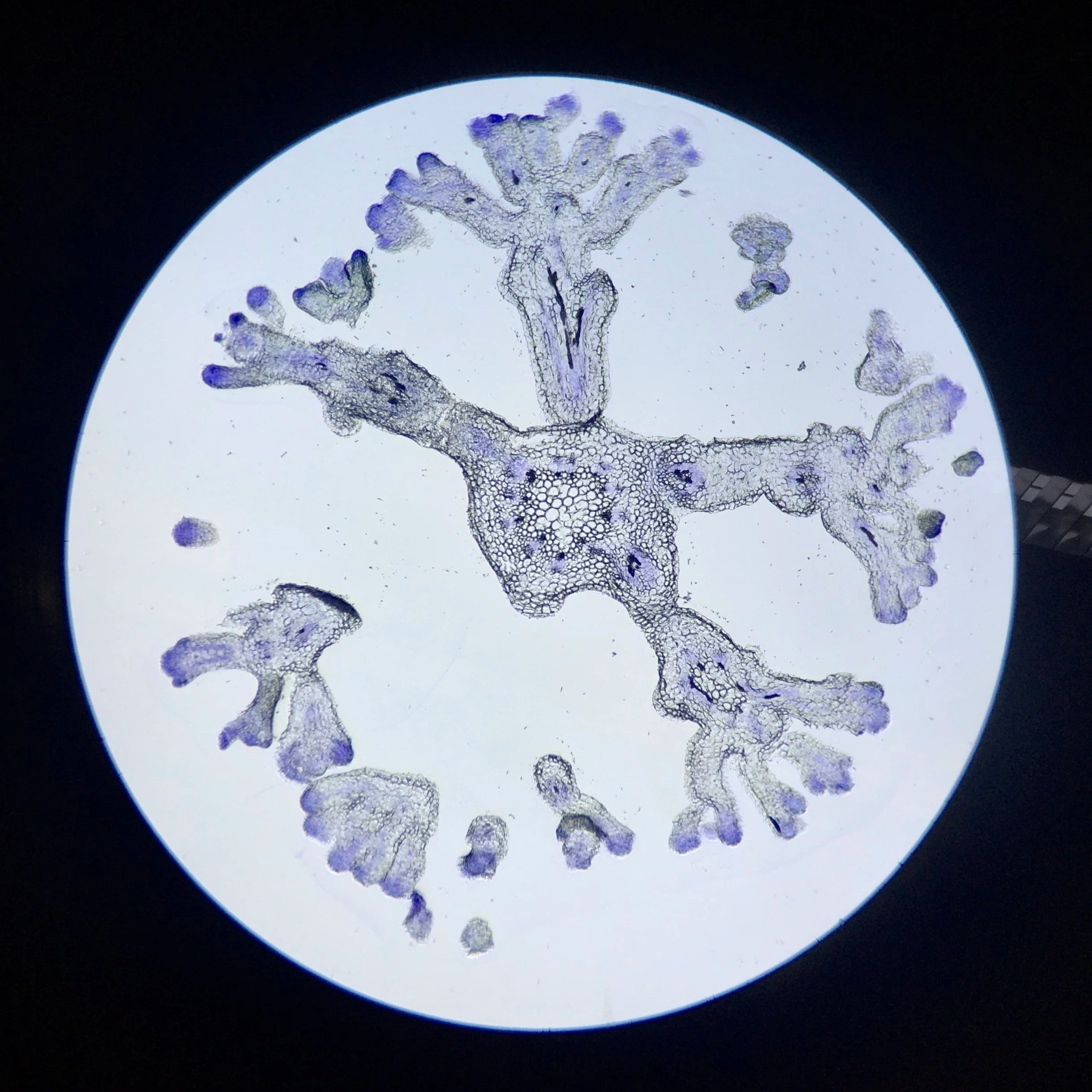
Seeing Plant Development: Adrienne is especially interested in visualizing growth.
“I really love to be able to watch development as it’s happening; I enjoy image processing to quantify development, and then computational modeling to explore our hypotheses.”
To fully understand this, Adrienne's lab members collaborate with students and postdocs from other labs.
“I really love working together with other people who have other skill sets, to bring all that together and get interesting projects done.”
She values creativity and independence in her students and postdocs. “I’m always looking for people who are going to lead their own project interestingly.”
Image credit: Byron Rusnak, Roeder lab
Looking ahead…
Adrienne’s imagination reaches beyond traditional plant science. One of her future directions involves engineering living materials, creating sustainable structures made from plants, bacteria, or fungi. “We need to replace a lot of materials with living materials that are more functional and sustainable,” she explains. "These organisms have amazing capabilities that make them great candidates to be the next generation of materials. We can engineer plants to grow into specific sizes and shapes that can be used for humans.”
She is collaborating with architects to explore how living systems, such as algae, can be incorporated into design and construction. “This is my next learning challenge,” she says. “I want to figure out how to translate these basic things we have been doing into this innovative space. I will keep doing my basic research, because we still have so much to learn in plant morphogenesis, and that knowledge will help drive this translation.”
Despite her forward-thinking approach, Adrienne stays grounded with the challenges of research. “Federal funding is always a concern,” she admits. “Basic research takes time. We need people to recognize its value and understand that it takes time to pay off.”
Adrienne is also optimistic about the future of science. “I’m really excited about AI, and we should be thinking about how this can help us to do amazing things. One of the biggest challenges is global climate change, that’s why I’m so interested in exploring new, sustainable directions that could help us adapt and innovate.”
Talking with Adrienne left me with a sense of inspiration. From her early fascination with plants to her groundbreaking work in plant morphogenesis, her journey reflects an enduring desire to understand better how life works and grows, and how that can inspire new ways of living sustainably.
At the end of the interview, she gave some advice to continue in a plant science career. “Don’t listen to all the negativity, go after what you want with passion and hope.” Sometimes hearing words like these motivate us to not give up and continue- like her science- growing.
-Interview & article by Vincent Cerbantez-Bueno, UC Riverside
Adrienne’s key contributions to NAASC…
Adrienne Roeder served as an active member of the North American Arabidopsis Steering Committee for five years. She was always willing to work on activities to support the community including as a member of the organizing committee for ICAR 2021, which was moved from Seattle in 2020 to the first fully virtual ICAR due to the Covid-19 pandemic, and ICAR 2024-San Diego. Her leadership, along with Anna Stepanova and myself, was key to developing the NAASC Arabidopsis Community Awards that recognize and honor individuals for their lifetime achievement using Arabidopsis for research, mentoring, and service, for making an exceptional positive impact on the community; and for disseminating Arabidopsis knowledge in diverse ways such as to the public, to K-12 schools, via sharing of resources, etc. Finally, as a key member of many NAASC working groups and subcommittees, Adrienne’s quiet and constant leadership helped contribute to advocating for Arabidopsis (and all fundamental plant biology) through scholarship such as these recent collaborative publications:
In defense of funding foundational plant science (article)
A timeline of discovery and innovation in Arabidopsis (article)
Focus on Translational Research from Arabidopsis to Crop Plants and Beyond (article)
These are only a few of the countless ways that Adrienne supported the Arabidopsis community during her years serving on NAASC!
- contributed by Joanna Friesner, NAASC Coordinator/Executive Director