George Rédei Seed Stock Award
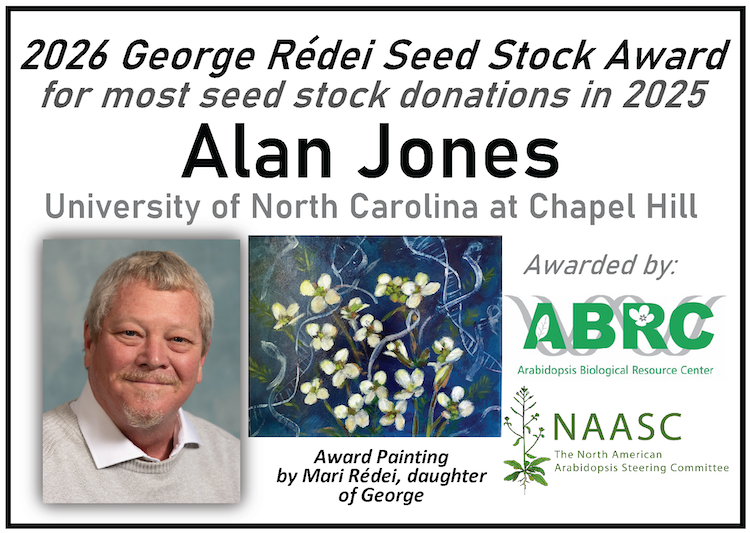
Dr. Alan Jones
University of North Carolina at Chapel Hill
I am very honored to receive the George Rédei Seed Stock Award as I have been a big fan of the ABRC from its inception. I believe that providing easy access to all germplasm has been foundational for the huge success of the Arabidopsis community. Not surprising; this worked for the Drosophila community even before George Rédei began his seminal work twenty years ahead of the rest of the world. Certainly, George had this model in mind.
When we publish peer-reviewed papers, we agree in that contract that our germplasm must be made accessible in a timely fashion for anyone who makes a request. This is not negotiable and one cannot hide behind vague government restrictions or onerous material transfer agreements that constrain research progress, not even for our “friendly competitors”. That is the main reason why we should deposit our germplasm into the ABRC upon publication of its first use.
But there is a practical reason as well. It did not take long for JonesLab to accumulate its first 200 unique lines and we realized that maintaining these lines through regular bulking and genotyping was costly and distracting us from our hypothesis-driven research. Requests for germplasm and mailing seeds around the world seemed to happen every week in those early days! The ABRC solved this logistical problem for us.
JonesLab created the first knock out lines of the heterotrimeric G protein pathway in 2000. In fact, this was maybe the second reverse genetics Arabidopsis germplasm published. Upon generating these mutants, we sent those lines to at least twelve labs that had already speculated that their favorite signaling pathway was coupled by a G protein. Our message was simple: “Now you can test your hypothesis directly with these new tools”. We were thrilled when Sarah Assmann took the challenge for what resulted in the most highly-cited paper on Arabidopsis G-protein signal transduction.
Soon after, JonesLab discovered the prototype of the 7-transmembrane Regulator of G Signaling protein family (AtRGS1) and the larger research community working on animal G signaling could no longer ignore Arabidopsis. From that point to today, Arabidopsis has had a seat at the NIH funding table in the Pharmacology Study Sections and the first time an Arabidopsis geneticist became a faculty member of a Pharmacology Department in a School of Medicine.
Thank you ABRC for all you have done for the Arabidopsis research community.
- Alan Jones, May 2026