background- This NAASC-organized webinar highlighted 4 professionals with backgrounds in plant science that engage in diverse aspects of scientific publishing. The panelists discussed their motivations to engage with scientific editing, writing, and publishing, the challenges they encountered, and what they found surprising and. rewarding. They also offered guidance on how doctoral students and postdocs can begin building experience as reviewers and transition into editorial roles.
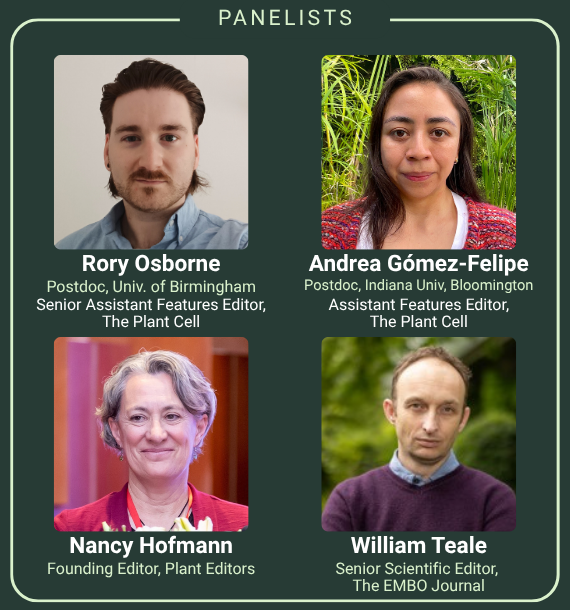
Panelists: Andrea Gómez-Felipe (Indiana Univ), Nancy Hofmann (Plant Editors), Rory Osborne (Univ of Birmingham), and William Teale (EMBO, the European Molecular Biology Organization).
Organizers: NAASC Early Career Scholars Subcommittee- Fernanda Gómez Méndez (UC Riverside, USA), Julia Zheku (Univ. of British Columbia, Canada), and Daniela De la Mora Franco, CINVESTAV, Mexico) Host: Joanna Friesner, NAASC Coordinator
What was your motivation to get engaged with scientific writing/editing/publishing?
Rory Osborne: I wanted to learn more about the process of scientific writing- how to sell an idea and tell a story. The AFE program (at The Plant Cell) was a great opportunity to develop that skill. Seeing behind-the-scenes at a society journal gave me a great appreciation of the whole process and this was helpful to me for improving my own writing. At The Plant Cell the decision to accept or reject a submission involves multiple people in a discussion which was helpful for me to improve my own writing- especially for abstracts and the cover letter.
Andrea: my motivation was that scientists aren't usually trained to be writers, and it was really hard for me to write my first paper. The AFE program has offered me a lot of support and feedback that has helped me improve my writing skills. Now it is easier for me to sit down and write a paper and try to be more clear. As part of the AFE program you also get to review papers and you can see that some papers aren't written well, or clearly.
Nancy: I had my first child around the time I submitted by PhD dissertation and I didn't feel like I could parent or do science as well as I wanted to, if I tried to do both at the same time. I decided to stay home with my kid and I planned to do a postdoc later. A couple years and another kid later, I was forwarded a job for freelance science editing and this turned out to be a great fit. It was flexible (for location and time), and it turned out that it was broad within plant biology and I really liked that. Also I realized in retrospect that I had done a lot of writing in my undergraduate and graduate years, and that I had struggled to narrow my focus and so it became clear that scientific editing was perfect for me.
William: a scientific career is competitive, difficult, time-limited and there's a pressure to get somewhere (quickly.) I was lucky to stay in that system but it came to a point where I was feeling like I couldn't access the questions at the bench that I wanted to. I saw an ad for EMBO journal editorial positions and I applied… the rest is history.
What did you find challenging about your efforts with scientific publishing/writing/editing?
Andrea: Scientists aren't usually trained to be writers, and as a non-native English speaker, it was even harder. Sometimes it's not easy to write a sentence because you want to be clear and concise, and attract interest.
Rory: The biggest challenge is time- our most precious resource- fitting in time to read a paper, fully digest it, and write an article was time-consuming. This is something that's probably universally accepted in academia.
Nancy: It's challenging sometimes to be outside academia as I didn't have access to journals and I needed to ask people for pdfs of their articles. Also, people are physically scattered so I had to be very deliberate about establishing and maintaining relationships.
William: You have to be good at making decisions as an editor. If you're the sort of person that makes decisions in steps- make a decision- then revisit it- then being an editor can be challenging.
What do you find most rewarding about your efforts with scientific publishing/writing/editing?
Nancy: creating jobs that keep people in science. They used to talk about the 'leaky pipeline' that was generally about young women leaving science. A lot of our editors are really excellent scientists that needed more flexibility about where they are working and when they are working, and it's been great for us to create roles that keep people in science.
William: This has to be accepting articles- it's a wonderful thing. Writing the congratulations letter is certainly the most rewarding part of the job.
Andrea: Doing the AFE program has helped train me to be more critical about how papers are written, and this helps me a lot with my own writing.
What did you find surprising about your efforts with scientific publishing/writing/editing?
Nancy: how much I enjoy the business part-making a business work- running the business.
William: being an editor is a lot like being a scientist later in your career, where you're not at the bench anymore. Instead, I was sitting in my office reading manuscripts and looking at experiments- giving them feedback- and waiting for them to come back with new versions. Now I do this, looking at experiments from scientists and waiting for them to come back with revisions.